What Is Cross-Platform Software? A Must-Know in 2026

Cross-platform software is one of the most common terms in software development, but what does it actually mean? Imagine using your favorite phone app and getting the same smooth experience on your computer, whatever operating system it runs. That is cross-platform software: applications built to work across different devices and platforms.
In this article, we look at the advantages and disadvantages of cross-platform development, the tools that make it work, and why it remains a smart choice for many businesses in 2026.
Cross-Platform Software: Convenience or Compromise?
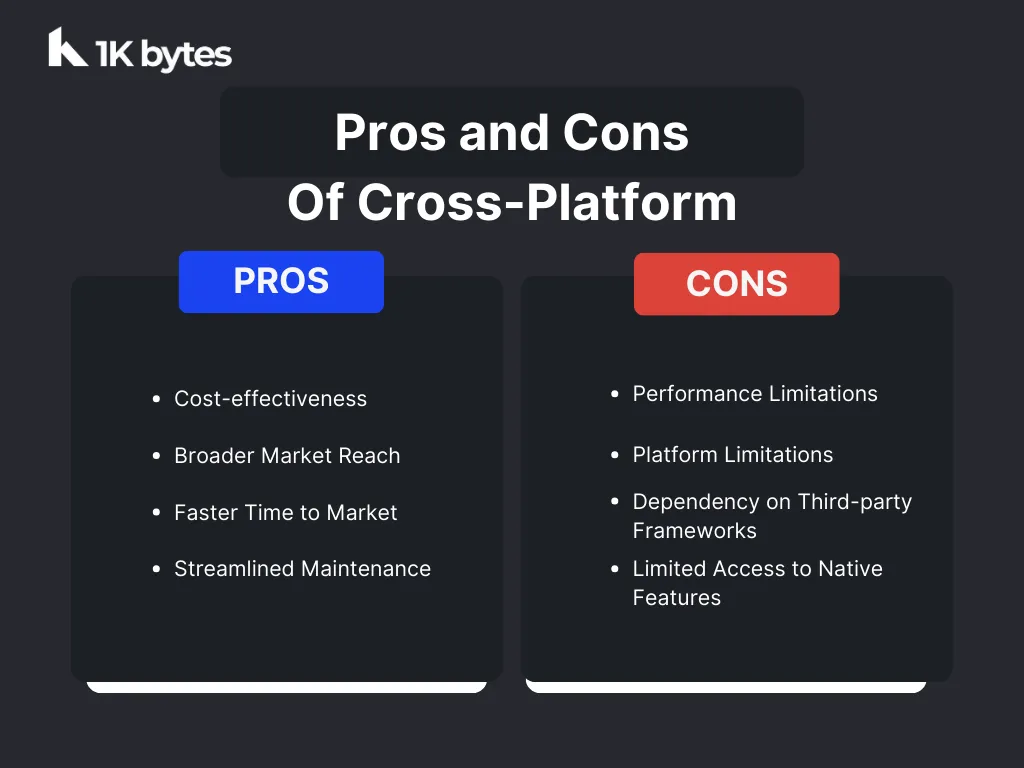
Pros
- Cost-effectiveness: With frameworks like React Native, Flutter, or .NET MAUI, developers write code once and deploy it on multiple platforms. That cuts development time and avoids maintaining a separate codebase for each platform.
- Broader market reach: You can target iOS, Android, and the web at the same time and reach more users without compromising the experience.
- Faster time to market: Reusing code speeds up delivery, which matters when being first can give you a competitive edge.
- Streamlined maintenance: With a single codebase, you fix a bug or ship an update once and it reaches every platform.
Cons
- Performance limits: Modern frameworks have narrowed the gap with native apps, but they may still fall short in resource-intensive apps, such as 3D graphics or heavy hardware use.
- Platform-specific tweaks: “Write once, run anywhere” rarely works perfectly. Optimizing for each platform or adding platform-specific features often takes extra work.
- Dependence on third-party frameworks: Updates or changes to a framework can affect your app’s stability, so dependencies need careful management.
- Limited access to native features: Plugins cover most needs, but features that rely heavily on new native APIs or specific hardware can be harder to implement.
Tools for Building Cross-Platform Apps
The table below covers the main tools for cross-platform development.
| Framework | Description | Functionality |
|---|---|---|
| React Native | Created by Meta, React Native lets developers build mobile apps with JavaScript or TypeScript and React. It renders real native components, so apps feel native. | Large ecosystem of components and libraries. Fast refresh for quick development cycles. Works well for teams that already use React on the web. |
| Flutter | Created by Google, Flutter is a UI toolkit for building natively compiled apps for mobile, web, and desktop from a single codebase. It uses the Dart language. | Full control over every pixel on screen. Rich set of ready-made widgets and extensive documentation. |
| .NET MAUI | Microsoft’s successor to Xamarin, which reached end of support in 2024. It builds apps for Android, iOS, macOS, and Windows with C# and .NET. | Shares business logic and UI across platforms. Integrates with Visual Studio. |
| Kotlin Multiplatform | Created by JetBrains, it lets teams share Kotlin code (such as business logic, and optionally UI) between Android, iOS, web, and desktop. | Shares only what you want while keeping native UI where it matters. |
Table 1: Tools for building cross-platform apps
Challenges and Considerations
No approach fits every project. Before you commit, keep these points in mind:
- Platform-specific features: Each platform has unique features and APIs. Plan how to support them without breaking compatibility.
- Performance optimization: Frameworks can add overhead, so test and profile on real devices.
- Framework selection: Choose based on your requirements, your team’s skills, and your target platforms.
- User experience: Design guidelines and device capabilities differ, so make sure the app looks and behaves appropriately on each platform.
Suitable Applications
Cross-platform development works especially well for:
- Business productivity tools: Project management, communication, and office tools need to be available on every device so teams can collaborate. Slack, Trello, and Microsoft 365 are familiar examples.
- Social and community apps: To reach a wide audience, these apps must work on iOS, Android, and the web with a consistent experience.
- Simple games: Casual games with straightforward mechanics often ship on several platforms to maximize reach. Games like Angry Birds and Fruit Ninja are available on both iOS and Android.
Success Stories
Before we look at examples, a quick note: OneK can build your cross-platform app.
WhatsApp grew quickly in part because it was available wherever its users were. By offering its messaging app on iOS, Android, the web, and desktop, it let people communicate regardless of their device, and it became one of the most widely used messaging platforms in the world.
Dropbox
Dropbox made file storage and sharing simple with apps for Windows, macOS, Linux, iOS, Android, and the web. Users can reach their files from any device, which made it a go-to tool for individuals and businesses.
The Future of Cross-Platform Software
Emerging Trends
- Progressive Web Apps (PWAs): PWAs combine the reach of the web with some native-like features, such as offline use and home screen installation. They run on any device with a modern browser.
- Shared-code frameworks: Flutter, React Native, and Kotlin Multiplatform keep maturing, giving developers more ways to share code while keeping native performance.
Technological Advancements
- Cloud computing and synchronization: The cloud lets data and settings follow users from device to device, and it enables real-time collaboration.
- AI-assisted development: AI coding tools now help teams write, test, and port code faster, which lowers the cost of supporting more than one platform.
Future Trajectory
- AR and VR: As augmented and virtual reality grow, so does demand for experiences that work across headsets, phones, and computers.
- Integration and interoperability: Users expect to switch between devices without friction. Open standards and consistent design help deliver that.
Cross-Platform vs. Native Apps
Developers usually choose between two roads: cross-platform and native. Each has its own strengths and trade-offs, and understanding them helps you pick the right path for your app.
| Aspect | Cross-Platform Development | Native App Development |
|---|---|---|
| Development approach | Write once, deploy across platforms | Separate codebase for each platform |
| Cost | Generally lower thanks to a single codebase | Higher because of separate codebases |
| Time to market | Faster | Longer |
| Performance | May not always match native performance | Optimized for each platform |
| Access to features | Limited access to some platform-specific features | Full access to platform features and APIs |
| User experience | Varies depending on the framework | Typically the most seamless |
| Maintenance | Easier with a single codebase | Requires maintaining multiple codebases |
| Learning curve | May require learning a new framework or language | Requires platform-specific languages and tools |
Table 2: Cross-platform vs. native app development
Conclusion
If you are a business owner with a strong app idea, cross-platform development can be the right fit. At OneK, a software studio in Tangier, Morocco, we build cross-platform apps that work smoothly on any device. Contact OneK to bring your idea to life.